



The digital asset market has produced extraordinary returns for early adopters, but it has also resulted in catastrophic losses for those who invested without proper research. In this volatile ecosystem, the primary differentiator between success and failure is due diligence.
Analyzing a cryptocurrency does not require an advanced degree in blockchain engineering. However, it does demand a structured approach that evaluates the right indicators in a logical order. This guide outlines the essential factors to audit, explains what they reveal about a project’s health, and introduces a tool designed to accelerate this entire workflow.
Step 1: understand what the project actually does
Before examining financial metrics, you must validate the project’s fundamental thesis. What specific problem does this cryptocurrency solve, and is a decentralized ledger truly necessary?
Read the project’s documentation or whitepaper. Look for a clear problem statement and a technically sound solution. Be skeptical of « buzzword-heavy » descriptions like « revolutionizing global finance » that lack specific implementation details. If a project has no working product or a poorly defined use case, the risk of failure increases exponentially.
Step 2: evaluate the team and development activity
In crypto, the quality of the core team is a leading indicator of execution capability. A strong team can navigate technical hurdles and sustain community trust during market corrections.
- Professional background: Verify the team’s experience in blockchain, cryptography, or finance via platforms like linkedin.
- Technical pulse: Check the project’s github repository. Regular « commits, » a high number of active contributors, and a growing codebase are objective signs of a healthy, evolving project. A dormant repository suggests the project may have been abandoned.
Step 3: analyze the tokenomics
Tokenomics; the economic structure of a token; is arguably the most critical yet overlooked aspect of analysis. Even a great product will underperform if its economic model creates constant selling pressure.
Key indicators to monitor:
- Total vs circulating supply: A large gap implies significant future inflation as locked tokens enter the market.
- Vesting schedules: Identify when early investors and team members can sell their holdings.
- Utility: Does the token have a functional role (fees, staking, governance), or is it purely speculative?
- Ownership concentration: Avoid projects where a few « whale » wallets control a majority of the supply.
Step 4: assess liquidity and market depth
Liquidity determines your ability to exit a position without causing a massive price drop. A project might look profitable on screen, but if the order books are thin, you are effectively trapped.
Check the daily trading volume relative to market capitalization. For DeFi protocols, monitor the TVL (total value locked) as a sign of user trust. Additionally, verify that the asset is listed on reputable, high-volume exchanges rather than obscure, unregulated platforms.
Step 5: evaluate community strength
The value of a network is often proportional to its user base. However, focus on engagement quality rather than raw follower counts.
Are members discussing the technology and roadmap, or is the conversation dominated by « moon » predictions and price hype? A community that grows organically through genuine interest is far more resilient than one built on paid promotional campaigns.
Step 6: check security and audit status
Security exploits cost investors billions every year. Before committing capital to a smart contract-based project, confirm it has been audited by a reputable firm such as certik, trail of bits, or openzeppelin. An audit doesn’t guarantee 100% safety, but the absence of one; or a refusal to publish the report; is a major red flag.
Step 7: analyze on-chain data
On-chain data provides the « ground truth » of a project’s activity, independent of any marketing claims.
- Active addresses: Increasing numbers suggest real adoption.
- Transaction volume: High organic volume indicates utility.
- Exchange flows: Monitoring large inflows to exchanges can help you anticipate upcoming sell pressure.
How cryptoscores simplifies this entire process
The manual research process described above is thorough but incredibly time-consuming. Gathering data from github, defillama, lunarcrush, and multiple exchanges can take hours for a single asset.
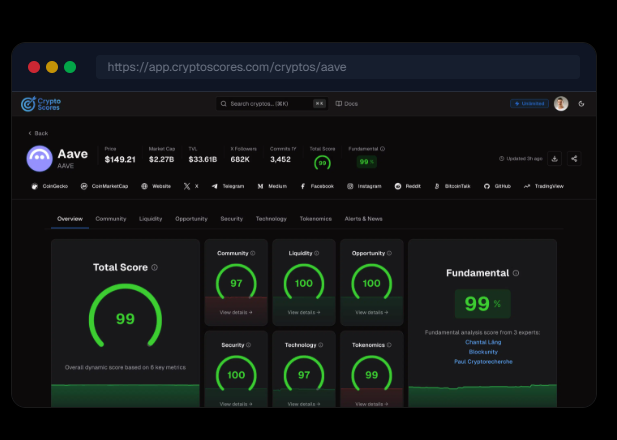
cryptoscores condenses this entire workflow into approximately 10 seconds. The platform monitors over 7,000 cryptocurrencies daily, applying 100+ metrics across the eight dimensions covered in this guide.
By aggregating data from the most trusted sources; including coingecko, artemis, de.fi, and tokenmetrics; cryptoscores generates a dynamic total score. Instead of managing dozens of browser tabs, you receive a structured, data-driven assessment that identifies both opportunities and risks instantly.
The bottom line: analysis is the investor’s edge
In a market where prices can shift 30% in a day, a rigorous analytical framework is your only real protection. These seven steps provide the foundation for sound due diligence.
With cryptoscores, you get the benefit of professional-grade analysis without the manual labor. It does the heavy lifting, allowing you to focus on making informed, strategic decisions.
Start your 14-day free trial today at www.cryptoscores.com and audit your first project in seconds.